UPC or APC: which fiber optic connector suits your network?
When specifying a fiber-optic network, the choice between UPC (Ultra Physical Contact) and APC (Angled Physical Contact) connectors is more than just a matter of color. The connector type affects signal quality, network reliability, and long-term performance.
The main difference lies in the return loss: the amount of light that is reflected back to the transmitter through a connector. Both types minimize signal loss and reflections, but in different ways, making each type suitable for specific applications and network conditions.
In this post, we’ll explain in simple terms what return loss is, why optical reflections matter, and when APC connectors are the right choice when designing or expanding your fiber-optic network.
Understanding Return Loss
At every connection in a fiber-optic network, a small portion of the light can be reflected back toward the transmitter. This back reflection can affect the optical signal.
Return loss indicates how much of this light is reflected back. The higher the return loss, the less reflection there is and the better the optical performance. Return loss is expressed in dB. A higher value indicates better performance:
Connector Type / Typical Return Loss
PC / 30–40 dB
UPC / 50–55 dB
APC / 60–70 dB
High return loss contributes to a stable, reliable, and high-quality fiber-optic connection, especially when minimal reflection is important.
Why Reflections Are Important
A stable and clean optical signal is essential for reliable fiber-optic communication. By minimizing unwanted reflections, the signal remains stronger and the likelihood of interference decreases.
This contributes to:
- Higher signal quality
- Fewer bit errors
- Reliable connections
- Longer transmission distances
- Optimal performance at high data rates
Minimizing reflections becomes particularly important for long distances, high speeds, and sensitive equipment. High-quality connectors with high return loss ensure less reflection, greater stability, and reliable network performance.
What is a UPC connector?
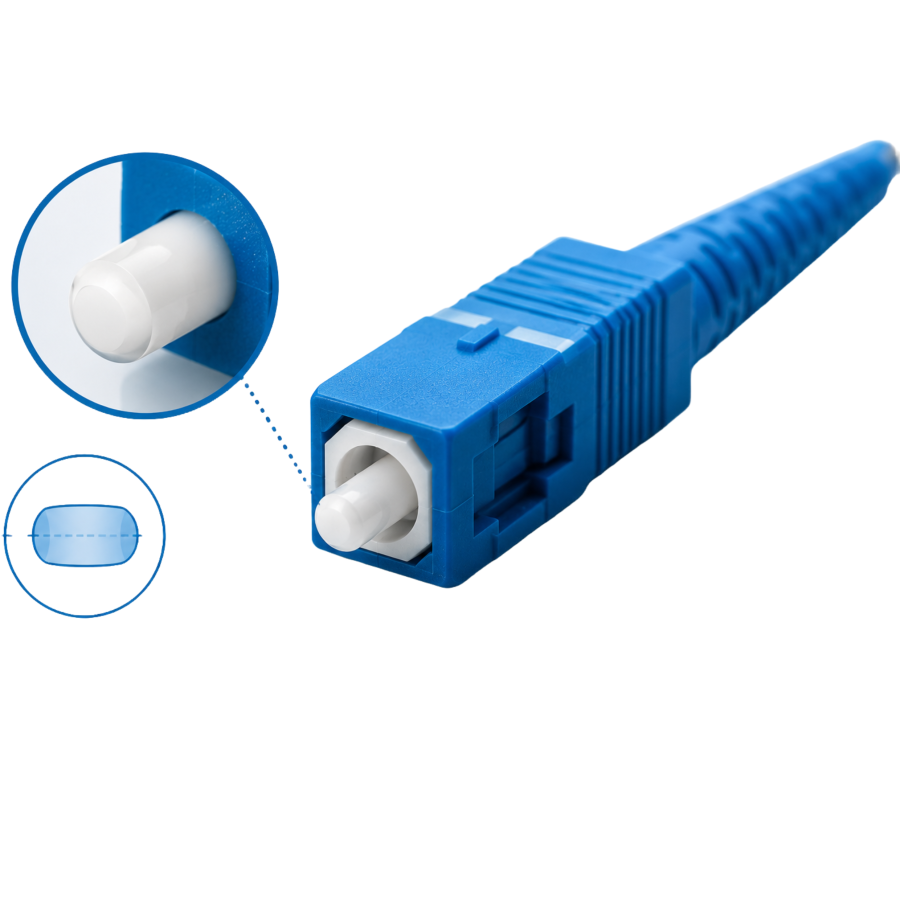
A UPC (Ultra Physical Contact) connector has a precision-polished ferrule with a slightly curved end face, allowing two fiber cores to connect with high precision. This results in low insertion loss and significantly less reflection than with older PC connectors.
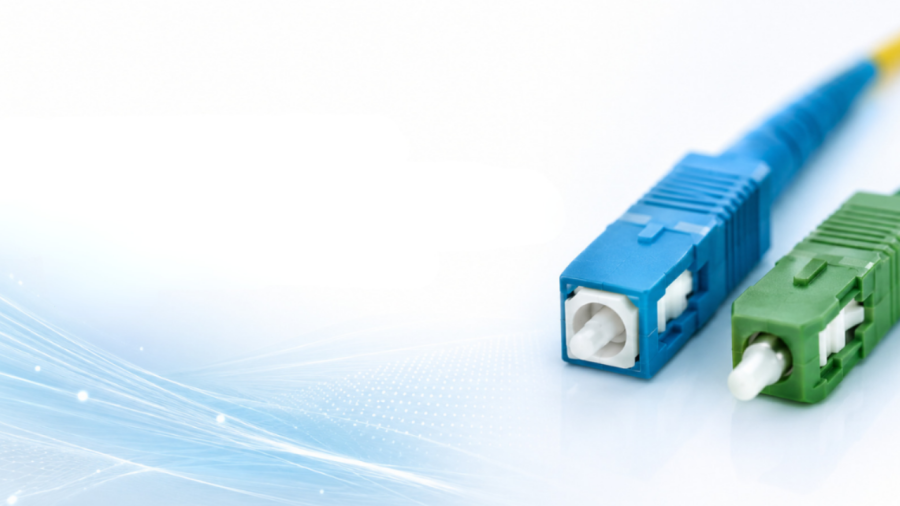
UPC connectors are recognizable by their blue housing and offer a good balance between optical performance, reliability, and price. They are widely used in:
- Enterprise LAN networks and data centers
- Campus and corporate networks
- Fiber optic patch panels
- Internal building cabling and backbone connections
This makes UPC a practical, reliable choice for many indoor installations, offering a good price-performance ratio.
What makes APC different?
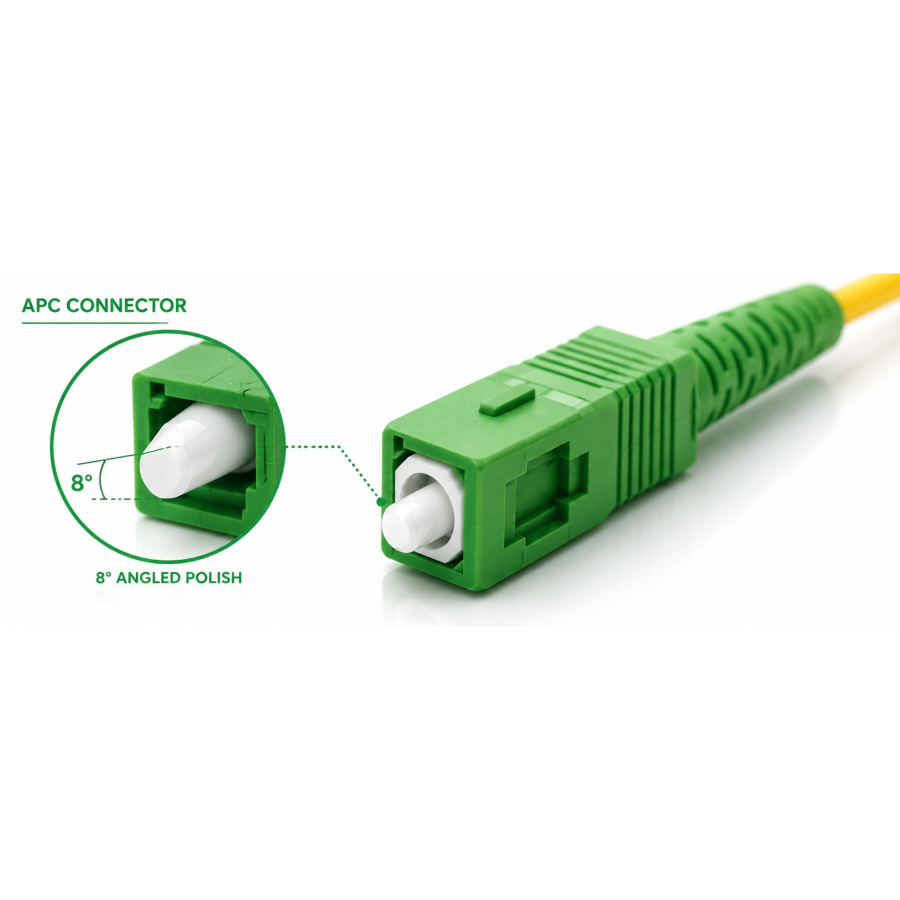
APC stands for Angled Physical Contact. The difference from UPC lies in the polishing: with APC, the end face is ground at an 8-degree angle instead of being flat. As a result, reflected light is not directed back toward the light source, but toward the fiber’s cladding, where it is absorbed without interfering with the signal.
This results in significantly higher return loss and thus far fewer unwanted reflections. As a result, APC is particularly well-suited for applications where high signal quality and minimal reflection are important.
APC connectors are recognizable by their green housing; they are the right choice for networks where optimal optical performance is key.
When are APC connectors the right choice?
Not every fiber-optic network requires APC connectors. In many commercial and indoor installations, UPC connectors are a perfectly adequate practical solution. APC connectors are particularly useful when minimizing optical reflections is essential for signal quality and reliability.
| Fiber to the Home (FTTH) | Internet service providers (ISP's) | CATV and RF over fiber optics | Optical networks |
|---|---|---|---|
| Passive optical networks (PON) transport signals over relatively long distances and serve multiple users from a single optical line terminal (OLT). APC connectors minimize reflections and contribute to stable signal transmission. | In the access and distribution networks of internet service providers, APC connectors help minimize reflections and maintain the integrity of optical signals. | Analog optical transmission is more susceptible to reflections. APC connectors minimize unwanted optical noise and signal distortions, thereby ensuring more stable signal transmission over longer distances. | For longer fiber-optic links and higher optical power levels, minimizing reflections becomes increasingly important. APC supports stable signal transmission over greater distances. |
Return Loss vs. Insertion Loss
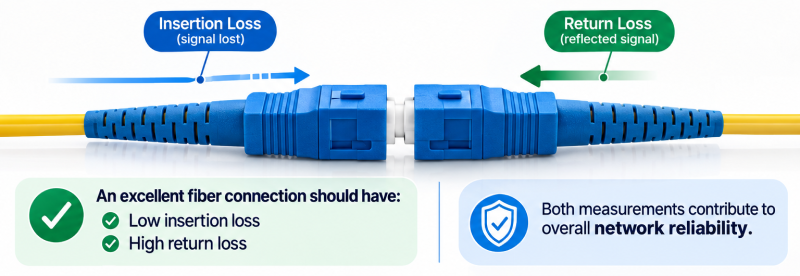
Return loss and insertion loss are often confused, but they describe two different aspects of a fiber-optic connection.
- Insertion loss indicates how much optical power is lost as the signal travels through a connection.
- Return loss indicates how much optical power is reflected back toward the source through the connection.
Insertion loss refers to forward signal loss, while return loss refers to unwanted reflection back toward the source.
Can UPC and APC be connected to each other?
This is an important consideration when installing fiber-optic connections. Although UPC and APC connectors can physically be mated, they must not be connected to each other. The different end-face geometries prevent the fibers from mating correctly. This can lead to:
- Increased insertion loss
- Additional optical reflections
- Damage to the polished connector surface
- Unreliable network performance
Therefore, always use the correct combination:
🔵 Blue → blue — UPC to UPC
🟢 Green → green — APC to APC
Always check the connector type before installation. This will prevent damage and ensure a reliable and optimal fiber-optic connection.
Choosing the Right Connector
Choose UPC for
- Corporate Networks
- Data Center Infrastructure
- General fiber-optic connections and repairs
- Building backbone networks
- Standard telecommunications connections
Choose APC for
- FTTH deployments
- GPON, XGS-PON, or other PON networks
- ISP access networks and CATV systems
- Long-distance optical connections
- Applications where minimal reflection is important
Fiber-optic connectivity
A reliable, high-performance fiber-optic network starts with high-quality components that are optimally matched to one another. DINTEK offers a complete line of pigtails:
Assortment of Pigtails